Saturday, 14 March 2015

Israel - Day 7 - Jerusalem

We caught our first glimpse of the city of Jerusalem last night right at dusk, to the strains of a stirring song about this city.
Our first expedition the next morning was to the outer corner of the western wall.
 Shmulik gave a wonderful explanation of the excavations, how the original street was much lower.  Over the years, layer upon layer had been added until the wall was much lower than it had originally been.


How thrilling to realize we were walking where Jesus walked.


 This is the famous "Wailing Wall", the inside of the Western Wall, the holiest spot for Jews.   
 Men went up to the wall on one side to pray.
Orthodox Jews put on their prayer shawls and yarmulkes, and wound
phylacteries around their arms,.  These were leather straps
with a little box attached which contained portions of the
Torah, the Jewish portion of the Scriptures. 


On the right was the women's section.  The custom
was to write out a prayer and stuff it into the cracks of the wall.  I found myself passing out little pieces of paper to the women of our group.  When there was
an opening, I added my prayer to the wall, and stayed there for a few moments.  It was a solemn
moment.


When Shmulik was in the Israeli army he and his buddies were leaning against a wall.  He didn't know it was the Western Wall, but they discovered a tunnel running parallel to the wall.


We noticed women sitting in corners along the way.  Our pastor explained they were trying to get as close as possible to the Holy of Holies, which had been on the inside of the wall, to recite the written prayers in their book.  In the Old Testament the Holy of Holies was the place of the presence of God, and only the priest was allowed to enter.  As Christians, we don't have to try to get near the Holy of Holies. When Jesus died on the cross, the temple curtain tore in two, symbolizing the free access we now have to the Father.  That is the Gospel, the good news!


At the Church of St. Anne, we sang the Doxology:

Praise God from whom all blessings flow.
Praise Him all creatures here below
Praise Him above ye heavenly host;
Praise Father, Son, and Holy Ghost.
A-a-men.

  The sound of our voices echoed in the old church with its wonderful accoustics.


The Church of all Nations where Mary and her parents were buried.
It was at the bottom of the Mount of Olives, from which we walked down the road Jesus rode on when he entered the city on a donkey, on what was later called Palm Sunday. The people were full of homage and praise, thinking Jesus had come to set up an earthly kingdom.


This large room, built in the 12th century, was the site of the Upper Room, where Jesus and His disciples ate their last Supper. I wondered if the actual room was really this big.


 In the Church of the Holy Sepulchre, Orthodox Christians wiping a slab of marble with oil.  It was supposed to have been the slab on which Jesus was laid when He was taken down from the cross. I think they were doing this as an act of devotion. The church itself was very crowded, as some churches believe it was the actual site of Jesus' tomb.  It was also very ornate. I would've liked to have explored it a  bit more, but not in that crowd. We were hustled along and cautioned to stay close together so as not to get lost.


Olive trees in the Garden of Gethsemane.  Some of these were so old they could've been there when Jesus spent his last night praying and agonizing over the upcoming event of his crucifixion.


Today had been a full day; we were glad to get back to the Dan Panorama Hotel to have another wonderful buffet dinner with its multitude of choices.  Bedtime was early and how great to finally sleep a solid eight hours!


Thursday, 12 March 2015

Israel - day 6 - Nazareth Village


Still in the Galilee area was a stop at Sepphoris, in what is now Zippori National Park. Excavations have uncovered the remains of a large city: a beautiful mosaic floor in a Roman villa displayed intricate mosaics.  The individual mosaics are tiny enough to show incredible detail, and an almost 3D effect.
The most famous of these is a woman's face, called "the Mona Lisa of the Galilee".


 Eighteen different shades of tiny mosaic allowed even a natural blush to appear on the woman's face.
Almond blossoms blooming in mid-February
In nearby Nazareth we climbed a little hill called the Mount of the Precipice.  Its southern face drops off into the Kesulot and Jezreel Valleys below.   Nazareth was Jesus' hometown, and he preached in the synagogue there, saying, "The spirit of the Lord is upon me because he has anointed me to preach the good news to the poor, to announce release to the captives, and recovery of sight to the blind, to deliver those that are opressed, and to proclaim the acceptable year of the Lord-- the day when salvation and the free favours of God profusely abound." (partly from the Amplified Bible, Luke 4:18, 19)  Although the people listened and marvelled at his words, the crowd later took offence at his further words and drove him towards the edge of the town, to this cliff, and were going to throw him off.   They didn't succeed, however, because Jesus slipped through the crowd.


The precipice

The Nazareth Village was a small area turned into a historical village with people wearing Biblical clothes and enacting Biblical daily occupations.
Anyone could volunteer to work there.


This is "Sarah", grinding her herbs in the little kitchen.  Imagine my surprise when she looked straight at me and said, "I know you!"
"No you don't!  I've never been here before!"
I replied.  Still staring at me, she said, "Kona, Hawaii."  Then I exclaimed, "It's Fritz!"
Lo and behold, we had worked with Fritz and her husband last winter at YWAM on the Big Island of Hawaii.  Everyone around thought my reaction was funny, but I truly didn't recognize her without her glasses and dressed in Biblical garb. (They were not allowed to wear glasses or jewelery)
Ernie and Fritz Warkentin from Winnipeg, MB
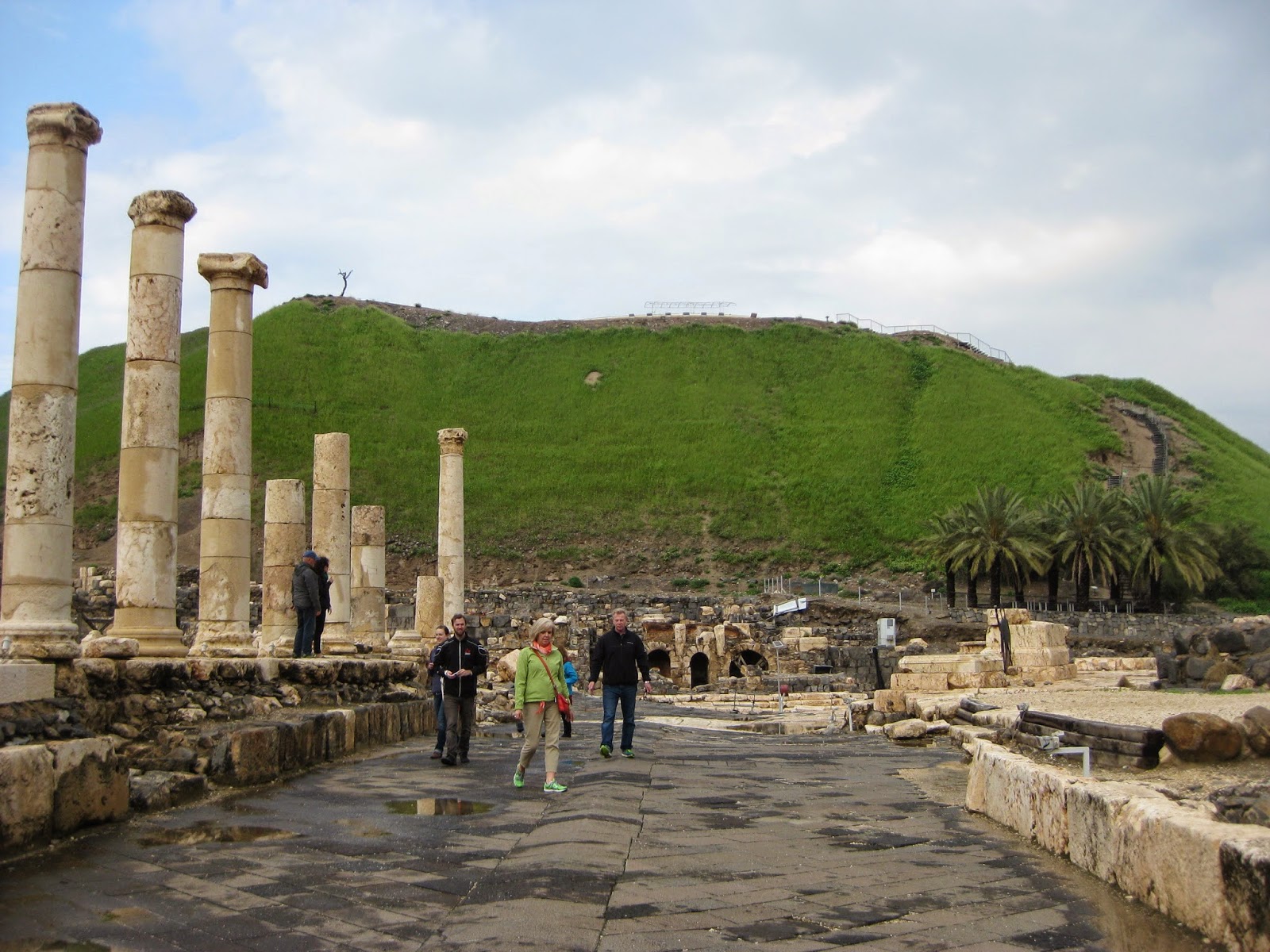
Beit Shean was the site of the largest archaeological dig in Israel.  In this ancient city, Saul's body had been nailed to the wall. ( I Samuel 31:10)
Roman bath


Wide city streets with standing columns which had been repaired a bit, after an earthquake toppled them. Someone took our picture, and I left my toque on a rock.  Later, it was too late to go back and get it.


 Close-up of a large paving stone showing the chariot grooves worn into it as people rode up and down the streets.


I took a picture of this heart-shaped indentation on the street.  I'm sure the rock wasn't pink when I looked at it, but on the picture it was!
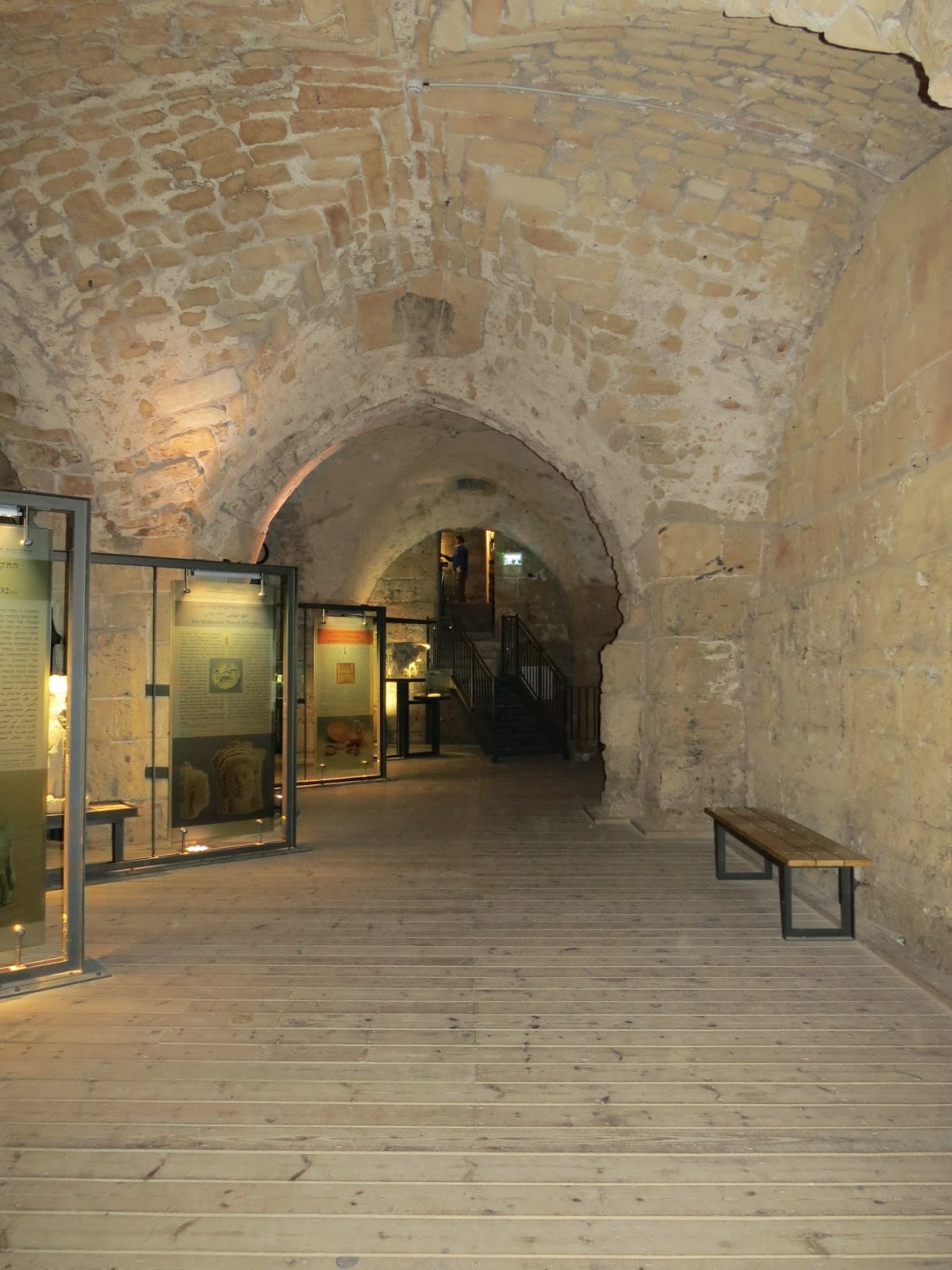
Since it was February 14, I call it my valentine from God.  He was showing me how much He loves me!

Wednesday, 11 March 2015

Israel - Day Five - Golan Heights

Kursi, on the eastern shore of the Sea of Galilee, was the day's first destination.  The ruins of a 6th century Byzantine basilica marked the site where Jesus healed the two men possessed by demons.  The church, Beit Alfa, was restored a bit in 1982. We stared at a floor with a crumbling mosaic, but it didn't really impress us.
Next stop, Banias, a cave in the north that is one of the three sources of the Jordan River.  We viewed a grotto carved in the rock, with a trickle of water emerging from it.
You can see us here with our hoods and umbrellas up. 

Banias is an Arabic word that comes from Pan, the flute-playing half goat, half man. His shrine in the grotto was referred to as the "Gates of Hell", hence Jesus' reference to the gates of Hell not prevailing in the Bible, as it was a pagan area. Banias was renamed Caesarea Philippi in honour of Herod's son, Philip.  
This was one of the towns Jesus visited with the disciples.


 Here is a 3D representation of the Golan Heights.  You can see how the high area towers over the rest of the landscape.  As we were driving through this area towards the Mt. Bental viewpoint, we found the road blocked.  Apparently the rain we were experiencing had turned to snow at higher heights.
Later, we stood at a former Israeli outpost overlooking Lebanon where two people had been shot not long ago!  We knew Shmulik would not have taken us anywhere dangerous, though.


Here is Terry's telephoto shot of a tower in Syria  to the east. Lebanon was to the west.
The border is still under army surveillance 24/7; there are still land mines in the area.


Snow capped hills


 Also in this Tel Dan National Park was Abraham's Gate.  By then we were all tired of climbing up and down uneven steps in the rain.  We were glad to stop for lunch in Qazrin at a fast food place.  There were only two choices:  a chicken dish I've forgotten the name of, and falafel pita, surprisingly good.  Even better was getting back to the hotel to have what my mother used to call "a nice cup of tea."

Monday, 9 March 2015

Israel - Day Four - Galilee

"Would we really go out in a boat on the lake in weather like this, while it's raining?" I thought to myself.  When I saw the size of the boat, I was reassured.
These were built for a boatload of tourists. We huddled together on the wet benches and tried to be cheerful


The crew members put on lively music, and this is one of the guys singing.
A little later, he had us all standing in a circle doing the hora.  Well, some of us anyway; I noticed Terry avoided this activity, although he had danced this type of dance in his phys ed classes back at university. Yes, there was enough room to do a dance. Well, that warmed us up quickly! Sorry, I couldn't take a picture; I was too busy.


The Sea of Galilee, or the Lake of Tiberias (it has several names) took at least half an hour to cross.  On the other side the Yigal Alon Museum houses the remains of a 2000 year old fishing boat,  the "Jesus Boat".  In 1986, when the drought drastically lowered the level of the lake it was discovered buried in the mud near the lakeshore.  Facinating how they preserved it by encasing it in foam to move it, soaking it in a chemical solution for years, letting it dry out, and then applying a special coating.  It's supposed to be an example of the type of fishing boat used by Jesus and his disciples, verified by a description by Josephus Flavius, a historian of the day.


The Mount of the Beatitudes was a gentle slope to the northwest.  Today, it is cluttered with buildings and churches, but it was interesting to note that the hill is shaped like a natural amphitheatre, amplifying the speaker's voice.  It was easy to imagine Jesus preaching to a crowd of 5,000. 

This Greek orthodox church, the Church of the twelve Apostles, in the nearby village of Capernaum, was a Byzantine addition, but we admired it for its lovely pink domes.

Here is the foundation of what is alleged to be the house of the apostle Peter.  Over the top of it a modern church of St. Peter, in an octagonal shape, was built in 1990, complete with glass floor to view the ruins underneath.


  The alabaster window of  the Byzantine church, the Church of the Multiplication of the Loaves and Fishes in nearby Tabgha.  The original church was built in the 5th century, but this later addition was built on the same floor plan.  An exposed rock under the altar is said to be the rock on which Jesus sat to expound to the people. 
Wonderful restored mosaics from the 5th century, depicting the basket of bread and the two fishes lay in front of the rock.


The highlight of the day was the baptism in the Jordan River, held at Yardenit, a prepared baptismal site.


Some of the group decided to be re-baptized for the experience and because of the special location. One had to rent a white cotton gown and a tiny towel to go with it. I jokingly told Terry and Bruce to put the towels on their heads, because they almost looked like the shawls devout Jewish men wore when they prayed.  Then I felt as though I was making light of the situation, but Terry told me he saw some other men with towels on their heads.


Terry was baptised as a child or an infant; he doesn't remember.  Today he chose to be baptised by immersion (the word baptised comes from the Greek word for "waterlogged") as was practised in the Bible.  I knew Terry was serious about it when he actually went through with his intent, despite the cold water.  There is almost nothing he hates more than being cold, not to mention being in cold water!  I can't even get him to go swimming any more in a normal lake.  Notice the pastor is wearing his wet suit.  Granted, he stood in the water longer than everyone else.


To Terry, this water must've seemed colder than the glacial Slocan Lake in the spring! To his credit, I didn't hear a word of complaint from him.


Terry's favourite place was Capernaum, where the ruins of an
ancient synagogue stood next to the octagonal St. Peter's church.
He shared how he had a feeling of incredible peace there, imagining
how it was in Jesus' day.

Sunday, 8 March 2015

Day Three Israel - Travelling North

Here is a picture of our comfortable bus, the handy chariot that got us quickly and easily from place to place.  One thing about Israel, it's not really very far to anywhere. See how we're all bundled up against the chill.
From Tel Aviv we drove north along the coast along the Via Maris (by way of the sea) on our journey towards Galilee.


Our first stop was Caesarea, the fortress city built by Herod the Great as the Roman administrative capital. where we disembarked to look at an old Roman aquaduct. These amazing structures were built to bring water to areas where it didn't occur naturally.

 Actually, there were two of them, parallel to each other. The first was built by the Romans under Herod the Great, who came to power in 22 BC, and  the second one, behind it, by Hadrian, who also built the famous wall in Great Britain. 


 A large amphitheatre had been unearthed from many layers of sand.  We didn't explore it as thoroughly as Terry and I had explored the one in Lyon, France, because it was so cold and windy.  Some of the younger people ran up and down the steps.

 `

The city of Caesarea was the doorway to the gospel to the gentiles, the non Jews, in New Testament times, when Peter was sent to the house of Cornelius. He was horrified to even enter the house of someone and eat foods that were taboo for Jews, but the Lord spoke to him, telling him it was part of his plan.  The apostle Paul was imprisoned here for two years, coming before the Roman emperor as a Roman citizen.  A film showed us an artist's impression of the temples and other buildings that used to be here, also the Hippodrome, a vast arena where sports and chariot races took place.


As we rode along, Shmulik would tell us fascinating facts about the vegetation, the terrain, and past history too detailed to keep up with.  Random fact:  Palm trees were not native to Israel, but 100 saplings were smuggled into the country in 1933 from the Persian Gulf. 


Next stop, Mediggo, one of King Solomon's walled fortified cities.  A small hill overlooking the fertile Plains of Sharon, was the top layer of a tel, Ahab's Tel. Underneath were 20 layers of civilization!  It was awesome to overlook the plain that would be the site of the future Battle of Armageddon.  Our first of several "tunnel walks" was through a tunnel built to redirect a spring from the opposite "mountain" range.  We couldn't even see to the other side, it was that foggy, although it was a narrow valley.
Then to Mount Carmel, which is actually a ridge of mountains.   In Bible times it was the site of Elijah's  famous challenge to the prophets of Baal.  One true prophet of God against 450 prophets of Baal.  God's power triumphed, as the fire of Elijah's sacrifice licked up even the water in the trench surrounding it.  Only 535 ft above sea level, it is now the sight of a Carmelite monastery.
modern representation of the prophet, Elijah


In the north the city of Acre was an important fortified port city during the Crusader era, in the early middle ages. We entered the huge reconstructed castle which was similar to many castles in Europe. In the name of Christianity the crusaders travelled to Jerusalem to liberate it from the Turks, but the reality was corruption and bloodshed along the way.
 It was raining and I was almost asleep on my feet, so I stopped taking notes for a while.


reconstructed crusader castle

The last straw in dampness!  A huge, 21 foot ocean wave crashed over the road where we had to walk for a bit, covering us with spray. 
My striped sweater, the outer layer out of five layers that day, was decidedly damp. 

Our destination that day was Ramot, a resort town in Galilee.  Our hotel wasn't actually on the Sea of Galilee, but near it.  We could see it the next morning from our window in between rain showers.

Day 2 - The Birth of a Nation

This is Independence Hall in Tel Aviv, where the 32 minute ceremony to declare the state of Israel took place on May 14, 1948.  A group of Grade Eight students from Chicago listened along with us to a guide who spoke very simply, but powerfuly, about events that took place nearly 67 years ago. How moving to hear the American students singing along with the Israeli national anthem as we all stood!  It was neat to think of Terry and I being born in this eventful year.
At the Hagana Museum another guide explained the history of the Hagana, a defense movement during the British mandate.  They would hold secret meetings in what looked most of the time like an ordinary-looking room.  This group evolved into the Israeli Defense Force, and one day after independence, Israel was attacked by Egypt, Iraq, Jorda, Syria and Lebanon.  Israel won the War of Independence and gained more territory.
The White Paper, published in Great Britain in 1939 made it illegal to immigrate to Israel, but many did.  Many were turned away, and some even returned to Germany. I thought it was time to reread the novel Exodus by Leon Uris. I would probably understand it a lot better now.
During the evaluation after our trip, many of us expressed our appreciation for the clear way this historical information was presented to us. It was a good idea to include this stop on our tour.

Sunday, 22 February 2015

Israel-- Day One--Tel Aviv

It took a number of years to have the desire to travel to Israel, but here we are!
Our group of 24 people landed in Tel Aviv,  the second largest city in Israel, and home of the first skyscraper in the middle east.  "Tel" is a mound made up of layers of civilization--this signifies the old. "Aviv" is the month of spring, and signifies new beginnings.   This word is even mentioned in the book of Ezekial, where God talks about dry bones taking on new life (Ezekial 3:15).
In the Old Testament, Jonah ran from God in Joppa, the old word for Jaffa, which the old part of the town is now called. In the New Testament, the good news of Jesus Christ was opened to gentiles in this place, as Peter obeyed God and went to the house of Cornelius. 

We strolled through charming old streets, and saw the spot where Simon the Tanner's house was said to have been.  I wonder what the current resident thought of all the foot traffic past their place, but it doesn't look as if he could see much; perhaps the windows are on the other side of the wall.
Simon the Tanner's house


Palm trees are not native to Israel, but someone once brought in some seeds.
Pastor Paul took every opportunity to link the location to incidents in the Bible.

Our hotel had a wonderful view of the Mediterranean Sea.  So far the weather was good; sunny but with a brisk wind.  It was to deteriorate in the coming week to rain, rain, and more rain.  Terry immediately began to photograph birds as we took our own walk after settling into the Carleton Hotel, and found nine species this first day.

The first night's dinner was very impressive; just a sample of what we would be having every single night. On the left is Shmulik, our knowledgeable Israeli tour guide.
I was in seventh heaven with the array of salads, yogurt and cheese products at breakfast, hummus, and halvah, and the dessert bar, which of course I had to sample every single night.  It took a few days to get our days and nights in the right order.
We looked forward to what the next few days would bring.