Saturday, 18 November 2017

Taj Mahal

Terry's shot with zoom lens
The Taj Mahal is an impressive structure in Agra, India, made of white marble. The emperor Shah Jahan built it in the seventeenth century to commemorate his favourite wife, who died in childbirth with their fourteenth child.   The cost to build was millions of dollars in today's currency.  When you take a closer look, you can see thousands of inlaid pieces of rock and semi-precious stones.
This Arabic writing is not painted on, but inlaid with black marble.


A close-up of some ornamentation in semi precious stones. 28 different types of stones were used in the whole structure!


The design of the building is Persian with Hindu elements.


 Terry was a amazed that there was nothing in this huge mausoleum except the tombs of the shah and his wife.  Even they were not visible, but buried under the ground within the building.  What we saw as we walked around inside, with fabric covers over our shoes, were replica tombs.

Formal gardens surrounded the Taj.  We spent most of our time posing for pictures by a professional photographer, and each have a whole album full.  If I had known this was going to happen, I would have been more dressed up for the occasion.  Instead, I had worn clothes for a "field trip" to be as comfortable as possible in the 32 degree heat.
one of the posed shots


We also explored the outside of a mosque made of red sandstone built on the same grounds


Why is the star of David on this archway?  I wondered.  I found out that the symbol had only been used by Jews for the last 200 years.  It was used by Islam and Hinduism much earlier.

The next day our bus took us to the red sandstone Agra Fort a couple of kilometres away, across the river. The fort was the main residence of the emperors until 1638.

Wonderful to have the chance to see these famous sites, but the heat made me less than totally enthusiastic.


This is how the Taj appeared through the smog from that vantage point.


Our group


Thursday, 16 November 2017

Traffic Adventures in India

Crazy traffic!  No real lanes.  A line down the middle of the road doesn't mean drivers stay where they're supposed to be. From our seat in the jeep, the cars appear to hurtle towards us.  We dodge ancient bicycles and motorcycles and tuk-tuks, the three wheeled small vehicles with open sides.  No rhyme or reason governs this road.  It's every man for himself.  Our driver expertly weaves through the maze of other vehicles, motorcycles, bikes, people, and even cows.  We're driving on the "wrong" side of the road as well, British style. I wish I could post the video we took. Pictures don't do justice to the traffic situation at all. On the backs of trucks these instructions are crudely painted, "Please use horn."  Horns are used liberally to indicate rapid lane changes and just to say, "Get out of my way!" Especially when another vehicle is coming right at you.
"Use dipper at night."  That one puzzled me, but I think they mean low beam lights instead of high beam. 
Yellow and green tuk-tuks

In a town of at least 100,000, traffic lights might have been there, but I didn't see any.  It's a weird feeling going around a traffic circle in the opposite direction.  In a bigger town, a policeman stands right there on the inner edge of the circle to direct traffic with one wave of the hand. 
Helmets are not generally used by motorcyclists, and certainly not by cyclists. Ladies in flowing saris perch sidesaddle behind the driver.

 Sometimes several people pile onto a motorcycle, even babies and toddlers are transported this way. 
An interesting sign read:  Slow and steady saves the face.  Is that to be taken literally? 
Another interesting sign by a bank in a wooded area:  Urinating prohibited, toilet ahead.  Some paid no attention.
Sound is not the only assault on the senses.  Brightly coloured saris on women stand out everywhere.  Children walk on the road dressed in school uniforms.  One school bus stopped at an intersection beside a guard rail, and children jumped out of the bus, onto the rail, and disappeared down the bank onto a small trail between the weeds. No flashing red lights there!
Dust and smoke is everywhere. This is how the Taj Mahal appeared from across the river in Agra.


One day in Delhi, the air was so filled with smog that flights were cancelled. They said it was like smoking 50 cigarettes.  Fortunately it was not as bad the few hours we were there, but certainly enough to be noticed.


Papers, plastic, trash, and cows, goats, and pigs.
When enough garbage accumulates, it is burned on the spot, adding to the air pollution.
Cow shares the median with a sleeping man

Monkeys by the side of the highway.
The cow rules the road


Cow patties for fuel drying in the sun

Building for rent


Friday, 6 October 2017

An Adventure at Gleaners

This oil painting (1857) by Jean-Francois Millet comes to mind when you hear the word Gleaners. The modern day application is quite different.

Whirrr! Shovel! Scoop! Spread! Stack!

What a busy time at the North Okanagan Valley Gleaners plant near Vernon, B.C.  Early on the morning shift, I had just selected a wonderful knife on the shelf, that cut cleanly and swiftly through the various sized beets in the large bin beside me. Terry was happily splitting giant cabbages with his machete-like knife.


Various shapes of veggies that don't make the market find their way to Gleaners.


Then I was asked to help "spread".  Abandoning my calm and fairly predictable post at the cutting station, I joined my friend who was already spreading the mix of diced beets and shredded cabbage onto trays that were to go into the dryer.

The diced vegetables had to be quickly patted into place with a few deft butterfly movements of the hand, just ahead of the next scoop that was waiting to be thrown onto the tray.

Here are carrots that are being scooped up to be flung onto the trays in rapid succession. I had to restrain myself from tidying someone else's spreading job when it was my turn to fit the trays into the many-slotted rack.  Sometimes when there was a moment's lull, I would furtively pat some vegetables into an empty looking corner of the sheet.  But there really were not many pauses, unless the dicing machine broke down. 
Then the machine had to be opened and the reason for the breakdown determined. Usually it was something like too much cabbage, which had to be mixed equally with beets to keep the vegetable cubes running freely.


I thought I knew what I was doing when my friend and I wheeled the trays into the dryer. 
Hmmm.  Why is this extra space here on the side? I thought.

No, no, no!  The trays have to go in this way, and we had to rearrange them all, down to lining them up with all the metal sheets in colour-coded order, and the stacks with the extra trays placed on the sides of the room to create proper air flow. Some time during the night, when the right level of dehydration is reached, the dryers automatically shut off.
The next morning the trays are scraped, and the now dried product collected into huge barrels, labelled with their contents, ready to be combined together into a soup mix to be shipped overseas to needy nations.  Apples and pears are packaged separately to be re-hydrated or eaten as a crunchy snack. 


Medical supplies are also collected by the North Okanagan Valley Gleaners. 

Terry stands by a pile of wheelchairs, walkers, and crutches, and later, helps to load some of them into a container destined for Guatemala.
Some crutches from the surplus in our town made their way to the collection. In the background you can see barrels full of the dried product.


Packages of dried soup mixes and fruit go into the container  first.


Various countries around the world are grateful recipients of the generosity of Canadian farmers, and our labour in processing the bounty.


 A very worthwhile project!
For more information, see www.novgleaners.org 

Saturday, 23 September 2017

Play date with Grandma and Grandma

When the boys were asked what they wanted to play when Grandma and Grandpa came for a visit, the quick choice was "Play dough!"
The big container was dumped out on the table, and we began.
"Oh, here's some new stuff!"
In the new can the play dough was smooth and flexible, moldable, and easy to form into shapes. While Little Sister happily transferred the old, lumpy play dough in and out of its container,  Big Brother pressed a lump of the new stuff into the piece of play equipment I call the garlic press.  Spaghetti-like strands extruded from the little holes, but turned into little bumps when he tried to pull the lump out.
"It looks like a cheese grater!"  I said.
Soon its wedge shape turned into an armchair. Then a man to sit in it. Then another wedge shape looked like a foot bath.  Our imaginations ran rampant.

Little Brother said, "I want a man and a chair, too!"
"OK!"
I told the boys, "My dad and I used to make things out of play dough when I was your age. Only it was called Plasticene."
"That was my great-grandfather," said Big Brother, who is six.
Wow, I thought to myself, quick thinking.

There's a Bible verse that in a modern translation says, Don't let the world squeeze you into its mold, that is, don't copy the behaviour and customs of this world. As a Christian, I'm to let God transform me into a new person by changing the way I think.  God is the One to do the squeezing, poking and stretching to mold me into the kind of person he wants me to be.  Sometimes the process is painful, like the play dough man who kept losing his arm.  I won't reach perfection any time soon because He's still working on me through the pokings and proddings of this life.  One day I will be changed to be like Him!

Monday, 21 August 2017

French Camp


Six years ago I began French Camp with my oldest grandchildren, and they've been going on every summer except the year we were in the throes of selling our beautiful log home. It was my daughter-in-law's idea, based on the week-long French Camps I had attended in Edmonton, while teaching school.  Caleb and Emma were being home schooled at the time, so it was supposed to enhance their education. I'm amazed at what they've learned over the years, and every year we add to it.
Bonjour, Georges!
Reviewing three digit numbers
This year the focus was parts of the body and their ailments, and the seasons and weather.
Georges, our French Camp mascot, was there, conversing with Petit Georges and Felix, a stuffed teddy.
Petit Georges a mal au pied


Coude, coude!

Dos, dos!


Monster drawings with random body parts:  
Il a trois yeux verts...

  The game Operation was hard to do, and not that
useful for learning.


Matching clothing items with the weather.


Mets la main gauche sur le cercle jaune!                                                                                                            

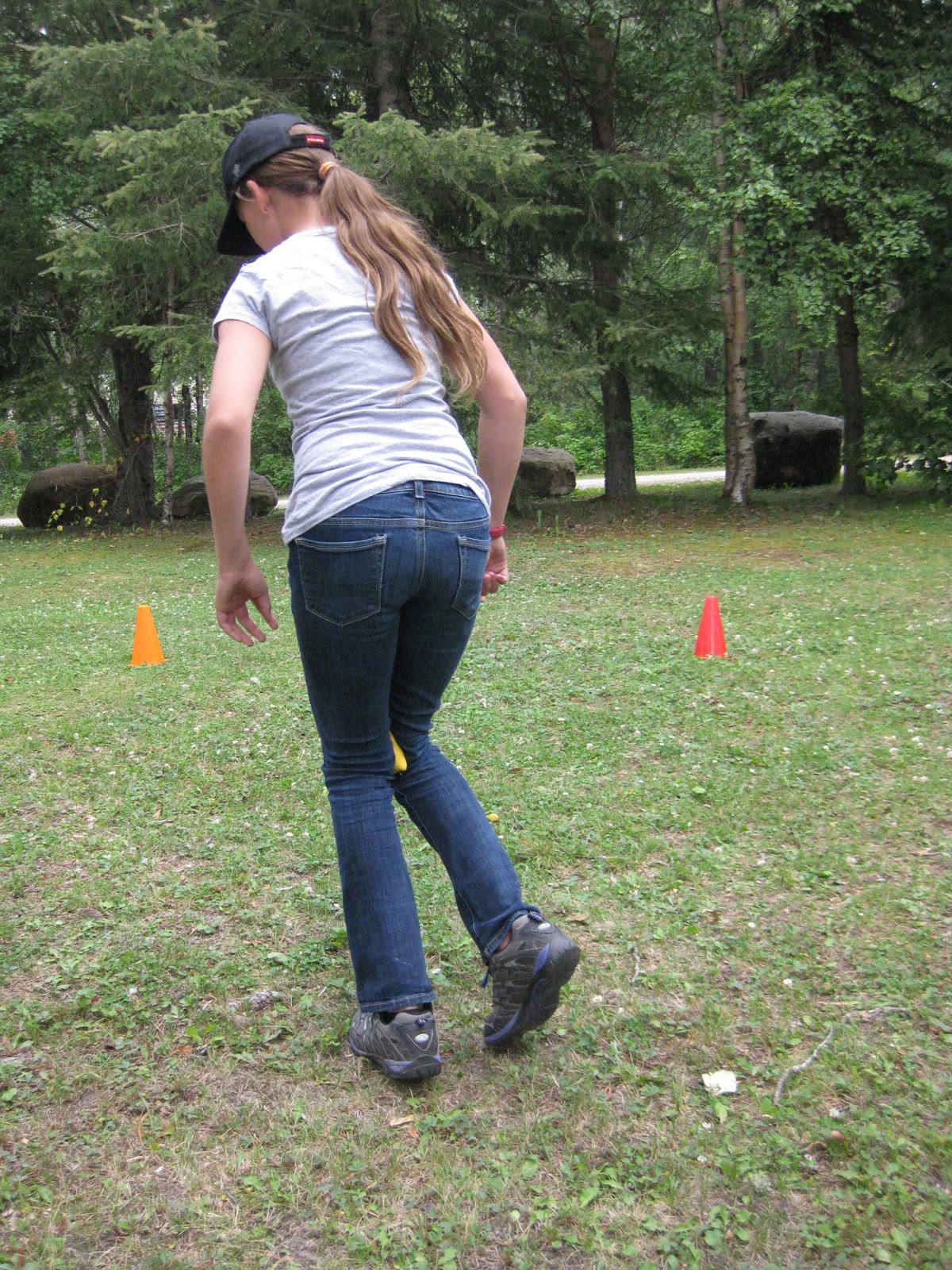
A picnic day was an opportunityto do some outdoor games.
Here Emma is carrying a beanbag between her knees.
An early birthday celebration.


Bonne Fete a toi! Treize bougies.


The "Littles" began their own French Camp this year.

Hard to do with the littlest one wanting in on the action.  Success!
Matteo matches colours and numbers using the dominoes.

Grandmaman is fatiguee, but contente.  See you next year!