Monday, 9 March 2015

Israel - Day Four - Galilee

"Would we really go out in a boat on the lake in weather like this, while it's raining?" I thought to myself.  When I saw the size of the boat, I was reassured.
These were built for a boatload of tourists. We huddled together on the wet benches and tried to be cheerful


The crew members put on lively music, and this is one of the guys singing.
A little later, he had us all standing in a circle doing the hora.  Well, some of us anyway; I noticed Terry avoided this activity, although he had danced this type of dance in his phys ed classes back at university. Yes, there was enough room to do a dance. Well, that warmed us up quickly! Sorry, I couldn't take a picture; I was too busy.


The Sea of Galilee, or the Lake of Tiberias (it has several names) took at least half an hour to cross.  On the other side the Yigal Alon Museum houses the remains of a 2000 year old fishing boat,  the "Jesus Boat".  In 1986, when the drought drastically lowered the level of the lake it was discovered buried in the mud near the lakeshore.  Facinating how they preserved it by encasing it in foam to move it, soaking it in a chemical solution for years, letting it dry out, and then applying a special coating.  It's supposed to be an example of the type of fishing boat used by Jesus and his disciples, verified by a description by Josephus Flavius, a historian of the day.


The Mount of the Beatitudes was a gentle slope to the northwest.  Today, it is cluttered with buildings and churches, but it was interesting to note that the hill is shaped like a natural amphitheatre, amplifying the speaker's voice.  It was easy to imagine Jesus preaching to a crowd of 5,000. 

This Greek orthodox church, the Church of the twelve Apostles, in the nearby village of Capernaum, was a Byzantine addition, but we admired it for its lovely pink domes.

Here is the foundation of what is alleged to be the house of the apostle Peter.  Over the top of it a modern church of St. Peter, in an octagonal shape, was built in 1990, complete with glass floor to view the ruins underneath.


  The alabaster window of  the Byzantine church, the Church of the Multiplication of the Loaves and Fishes in nearby Tabgha.  The original church was built in the 5th century, but this later addition was built on the same floor plan.  An exposed rock under the altar is said to be the rock on which Jesus sat to expound to the people. 
Wonderful restored mosaics from the 5th century, depicting the basket of bread and the two fishes lay in front of the rock.


The highlight of the day was the baptism in the Jordan River, held at Yardenit, a prepared baptismal site.


Some of the group decided to be re-baptized for the experience and because of the special location. One had to rent a white cotton gown and a tiny towel to go with it. I jokingly told Terry and Bruce to put the towels on their heads, because they almost looked like the shawls devout Jewish men wore when they prayed.  Then I felt as though I was making light of the situation, but Terry told me he saw some other men with towels on their heads.


Terry was baptised as a child or an infant; he doesn't remember.  Today he chose to be baptised by immersion (the word baptised comes from the Greek word for "waterlogged") as was practised in the Bible.  I knew Terry was serious about it when he actually went through with his intent, despite the cold water.  There is almost nothing he hates more than being cold, not to mention being in cold water!  I can't even get him to go swimming any more in a normal lake.  Notice the pastor is wearing his wet suit.  Granted, he stood in the water longer than everyone else.


To Terry, this water must've seemed colder than the glacial Slocan Lake in the spring! To his credit, I didn't hear a word of complaint from him.


Terry's favourite place was Capernaum, where the ruins of an
ancient synagogue stood next to the octagonal St. Peter's church.
He shared how he had a feeling of incredible peace there, imagining
how it was in Jesus' day.

Sunday, 8 March 2015

Day Three Israel - Travelling North

Here is a picture of our comfortable bus, the handy chariot that got us quickly and easily from place to place.  One thing about Israel, it's not really very far to anywhere. See how we're all bundled up against the chill.
From Tel Aviv we drove north along the coast along the Via Maris (by way of the sea) on our journey towards Galilee.


Our first stop was Caesarea, the fortress city built by Herod the Great as the Roman administrative capital. where we disembarked to look at an old Roman aquaduct. These amazing structures were built to bring water to areas where it didn't occur naturally.

 Actually, there were two of them, parallel to each other. The first was built by the Romans under Herod the Great, who came to power in 22 BC, and  the second one, behind it, by Hadrian, who also built the famous wall in Great Britain. 


 A large amphitheatre had been unearthed from many layers of sand.  We didn't explore it as thoroughly as Terry and I had explored the one in Lyon, France, because it was so cold and windy.  Some of the younger people ran up and down the steps.

 `

The city of Caesarea was the doorway to the gospel to the gentiles, the non Jews, in New Testament times, when Peter was sent to the house of Cornelius. He was horrified to even enter the house of someone and eat foods that were taboo for Jews, but the Lord spoke to him, telling him it was part of his plan.  The apostle Paul was imprisoned here for two years, coming before the Roman emperor as a Roman citizen.  A film showed us an artist's impression of the temples and other buildings that used to be here, also the Hippodrome, a vast arena where sports and chariot races took place.


As we rode along, Shmulik would tell us fascinating facts about the vegetation, the terrain, and past history too detailed to keep up with.  Random fact:  Palm trees were not native to Israel, but 100 saplings were smuggled into the country in 1933 from the Persian Gulf. 


Next stop, Mediggo, one of King Solomon's walled fortified cities.  A small hill overlooking the fertile Plains of Sharon, was the top layer of a tel, Ahab's Tel. Underneath were 20 layers of civilization!  It was awesome to overlook the plain that would be the site of the future Battle of Armageddon.  Our first of several "tunnel walks" was through a tunnel built to redirect a spring from the opposite "mountain" range.  We couldn't even see to the other side, it was that foggy, although it was a narrow valley.
Then to Mount Carmel, which is actually a ridge of mountains.   In Bible times it was the site of Elijah's  famous challenge to the prophets of Baal.  One true prophet of God against 450 prophets of Baal.  God's power triumphed, as the fire of Elijah's sacrifice licked up even the water in the trench surrounding it.  Only 535 ft above sea level, it is now the sight of a Carmelite monastery.
modern representation of the prophet, Elijah


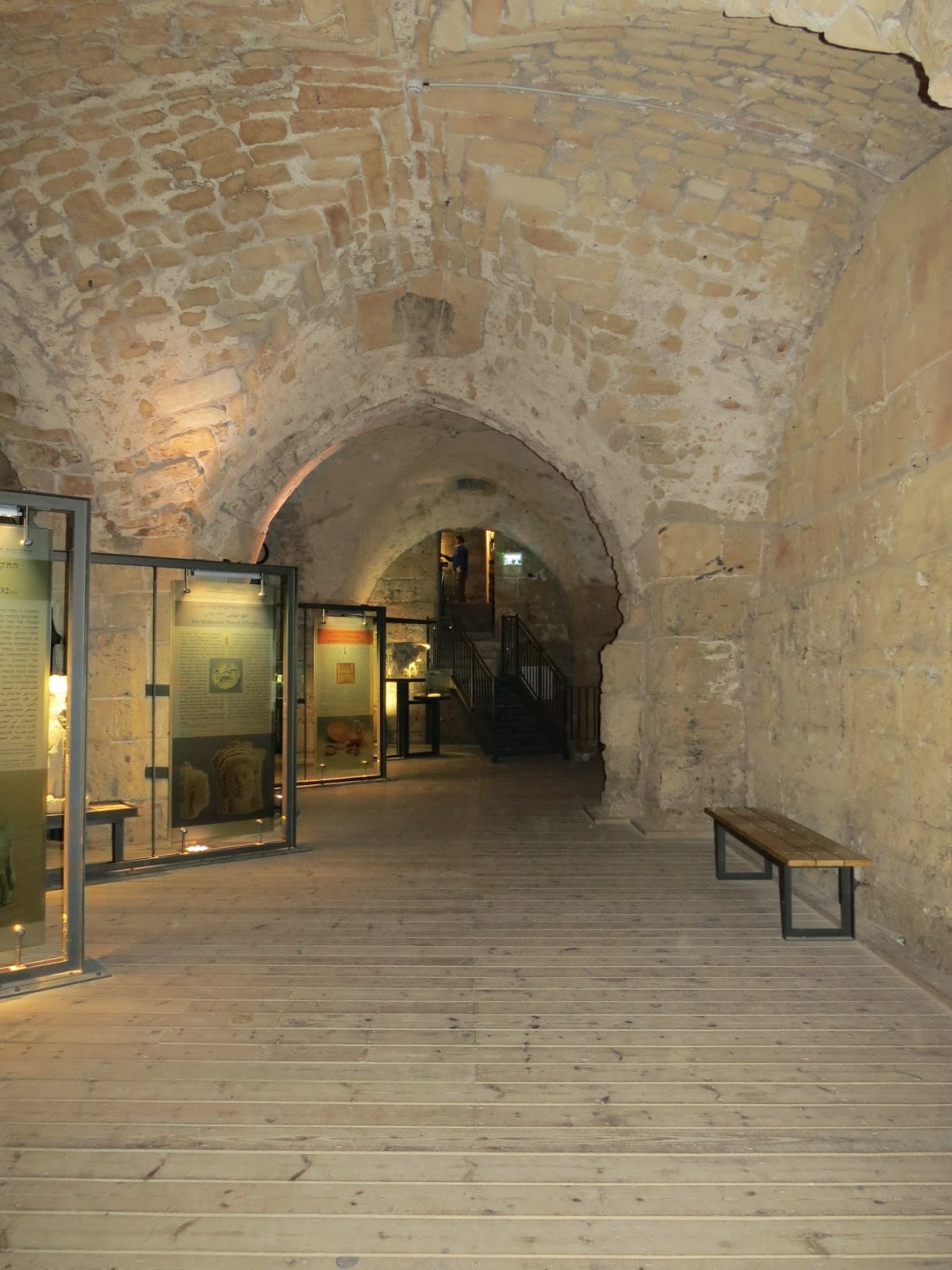
In the north the city of Acre was an important fortified port city during the Crusader era, in the early middle ages. We entered the huge reconstructed castle which was similar to many castles in Europe. In the name of Christianity the crusaders travelled to Jerusalem to liberate it from the Turks, but the reality was corruption and bloodshed along the way.
 It was raining and I was almost asleep on my feet, so I stopped taking notes for a while.


reconstructed crusader castle

The last straw in dampness!  A huge, 21 foot ocean wave crashed over the road where we had to walk for a bit, covering us with spray. 
My striped sweater, the outer layer out of five layers that day, was decidedly damp. 

Our destination that day was Ramot, a resort town in Galilee.  Our hotel wasn't actually on the Sea of Galilee, but near it.  We could see it the next morning from our window in between rain showers.

Day 2 - The Birth of a Nation

This is Independence Hall in Tel Aviv, where the 32 minute ceremony to declare the state of Israel took place on May 14, 1948.  A group of Grade Eight students from Chicago listened along with us to a guide who spoke very simply, but powerfuly, about events that took place nearly 67 years ago. How moving to hear the American students singing along with the Israeli national anthem as we all stood!  It was neat to think of Terry and I being born in this eventful year.
At the Hagana Museum another guide explained the history of the Hagana, a defense movement during the British mandate.  They would hold secret meetings in what looked most of the time like an ordinary-looking room.  This group evolved into the Israeli Defense Force, and one day after independence, Israel was attacked by Egypt, Iraq, Jorda, Syria and Lebanon.  Israel won the War of Independence and gained more territory.
The White Paper, published in Great Britain in 1939 made it illegal to immigrate to Israel, but many did.  Many were turned away, and some even returned to Germany. I thought it was time to reread the novel Exodus by Leon Uris. I would probably understand it a lot better now.
During the evaluation after our trip, many of us expressed our appreciation for the clear way this historical information was presented to us. It was a good idea to include this stop on our tour.

Sunday, 22 February 2015

Israel-- Day One--Tel Aviv

It took a number of years to have the desire to travel to Israel, but here we are!
Our group of 24 people landed in Tel Aviv,  the second largest city in Israel, and home of the first skyscraper in the middle east.  "Tel" is a mound made up of layers of civilization--this signifies the old. "Aviv" is the month of spring, and signifies new beginnings.   This word is even mentioned in the book of Ezekial, where God talks about dry bones taking on new life (Ezekial 3:15).
In the Old Testament, Jonah ran from God in Joppa, the old word for Jaffa, which the old part of the town is now called. In the New Testament, the good news of Jesus Christ was opened to gentiles in this place, as Peter obeyed God and went to the house of Cornelius. 

We strolled through charming old streets, and saw the spot where Simon the Tanner's house was said to have been.  I wonder what the current resident thought of all the foot traffic past their place, but it doesn't look as if he could see much; perhaps the windows are on the other side of the wall.
Simon the Tanner's house


Palm trees are not native to Israel, but someone once brought in some seeds.
Pastor Paul took every opportunity to link the location to incidents in the Bible.

Our hotel had a wonderful view of the Mediterranean Sea.  So far the weather was good; sunny but with a brisk wind.  It was to deteriorate in the coming week to rain, rain, and more rain.  Terry immediately began to photograph birds as we took our own walk after settling into the Carleton Hotel, and found nine species this first day.

The first night's dinner was very impressive; just a sample of what we would be having every single night. On the left is Shmulik, our knowledgeable Israeli tour guide.
I was in seventh heaven with the array of salads, yogurt and cheese products at breakfast, hummus, and halvah, and the dessert bar, which of course I had to sample every single night.  It took a few days to get our days and nights in the right order.
We looked forward to what the next few days would bring.

Saturday, 6 December 2014

The Apache Trail

On our day off, Terry and I inched our way through morning commuter traffic on the  first outing of our month in Phoenix.  Our destination was Apache Junction, the starting point of a former stagecoach route, the oldest highway in the United States. The Apache Trail winds 40 miles (64 km) through the Superstition Mountains north east of Phoenix.
 

At the visitors' centre we armed ourselves with information and maps, and headed towards the mountains


First we stopped at a touristy ghost town, Goldfield.  "Do you want to ride the train?" asked Terry. I thought we might as well get into the mood, so we  took a twenty minute ride around the town made up of reconstructed buildings, listening to the engineer's drawled commentary.


On the periphery of Goldfield


A train pulling mining cars


We took a quick look around. It was much like other ghost towns.


Next stop, the Lost Dutchman State Park.  Should we hike first, or have our picnic?  I settled for an apple and a granola bar for the time being, and we set off on the marked trails between the cacti.  An hour and a half later, were had made a loop and were back at our starting point.


The area is dotted with the Saguaro Cactus, the state plant of Arizona. The ones with arms are already more than a hundred years old. 
This measuring stick shows an annual growth of at least six inches.  


This one is nearing the end of its days


Eventually it splits apart . I'm not sure if this is decaying material, or material from a bird's nest. It's packed in there like filling in a cavity.


I like to document flowers.  This is the brittlebush, common in the desert.  Terry and his work partner cleared  clumps of these low bushes from around the fence surrounding the football field last month.  He said its stems were dry and brittle and snapped into pieces easily.  The yellow flowers added a splash of colour to the otherwise greenish- grey of the desert. 


Chuparosa- hummingbird flower


The creosote bush conserves moisture by its small, waxy leaves.  Before it rains, it sends forth a creosote-like smell ; also if you crush its leaves.  Its flower is a small fuzzy globe like a round pussy willow.


Prickly pear cactus has small red fruit in the summer.
At Pusch Ridge Christian Academy last month, the Grade Six class harvested the fruit with tongs, and their teacher and volunteer mothers made prickly pear jelly to sell.  This would fund their annual field trip to the Grand Canyon.  A bit tart, but flavourful!


Terry likes to photograph birds with his zoom lens.  This is an American Kestrel, a summer bird in Alberta, magnified 200 times.


The best bird of the day, though, was this black-throated sparrow, seen very rarely in Alberta, but common in the desert.  Terry thinks he may have seen it once at home. Many of them flitted on the ground as we walked along the trail through low shrubs. 


Finally we had our picnic!  Terry had brought his own fire wood from Canada, knowing most places no longer supply it; you're not even allowed to collect dead wood on site.  Of course he brought lumber, scavenged from old pallets at Canadian Tire, and from the collection in Nick's garage, because you can't bring wood with bark on it across the border.  This was our first barbecue of the "winter" season, and very satisfying, if not a bit sterile looking!  The child in me loves wiener roasts.
Our nitrite free wieners cooked quickly
Having lunch in the warm sun

 Past the state park, the road wound further through the mountains.  The first lake was Canyon Lake.  The next was Apache Lake.  Between them, the famous town of Tortilla Flat--population 6!  We didn't get any pictures, as the sun was beginning to sink below the mountains.  My interior picture of the ice-cream parlour didn't turn out--the walls and ceiling plastered with autographed dollar bills, some from other countries. We did tour a tiny museum which was supposed to be the size of the former one room school house.

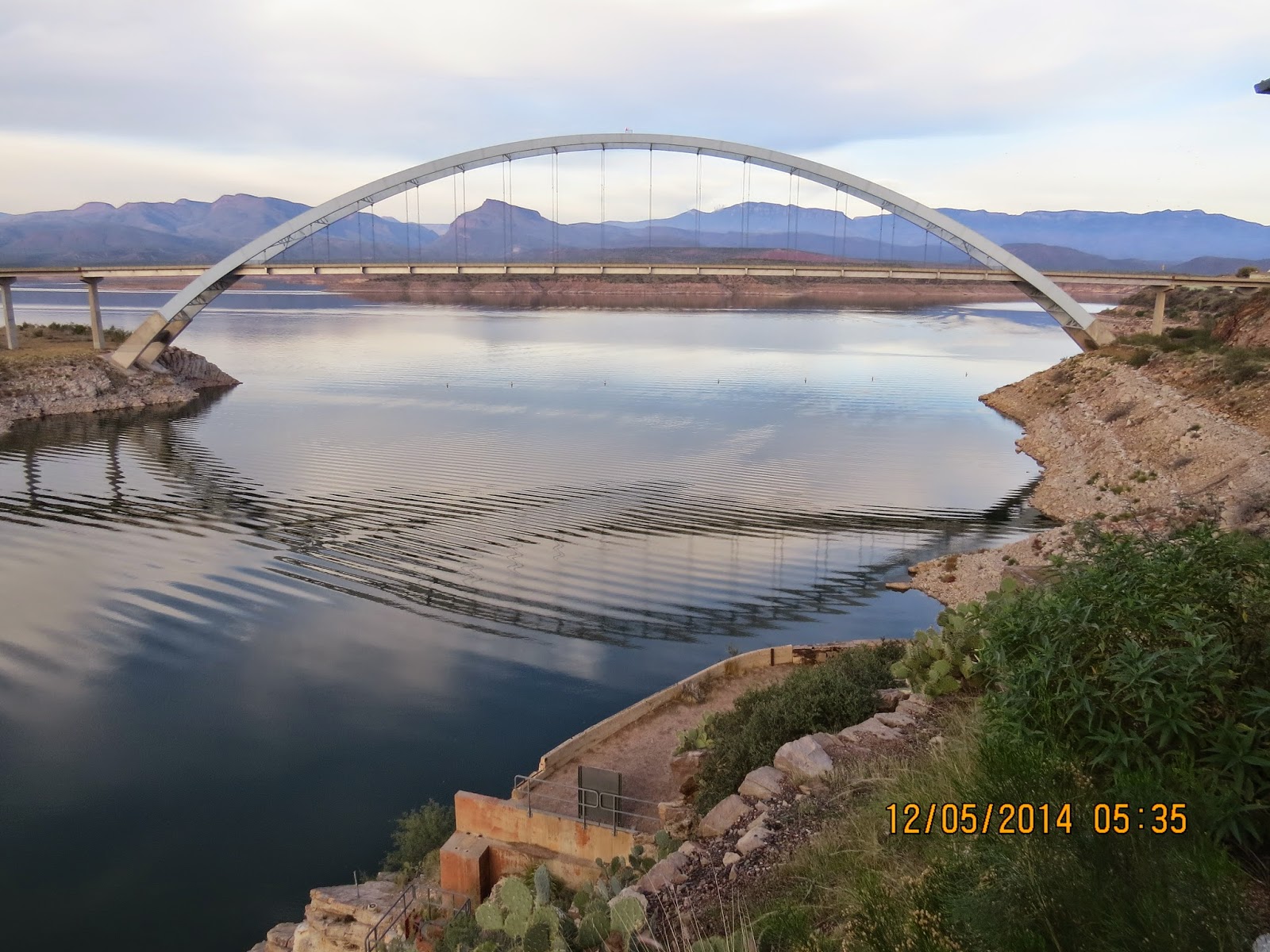
We travelled twenty-two miles of winding gravel road which hugged the edge of the cliff with no railings. It was a good thing there was no one else on the road, as some parts were only one lane wide. Terry had had a lot of practice from our New Denver days, before they improved the highway high above Slocan Lake.  Eventually we came across  the Roosevelt Dam, finished in 1911. 

Roosevelt Lake


After this, there was only one site left to see in the Tonto National Monument, but they were just closing.  Terry had wanted to see the cliff dwellings, but it was too late.  We completed the loop and went home the long way in the gathering dark.  A wonderful day!

You are worthy, O Lord our God, to receive glory and honour and power.
For you created all things, and they exist because you created what you pleased.   Revelation 4:11